
Brain-Computer Interfaces (BCI): Early Adopter Enterprise Use Cases
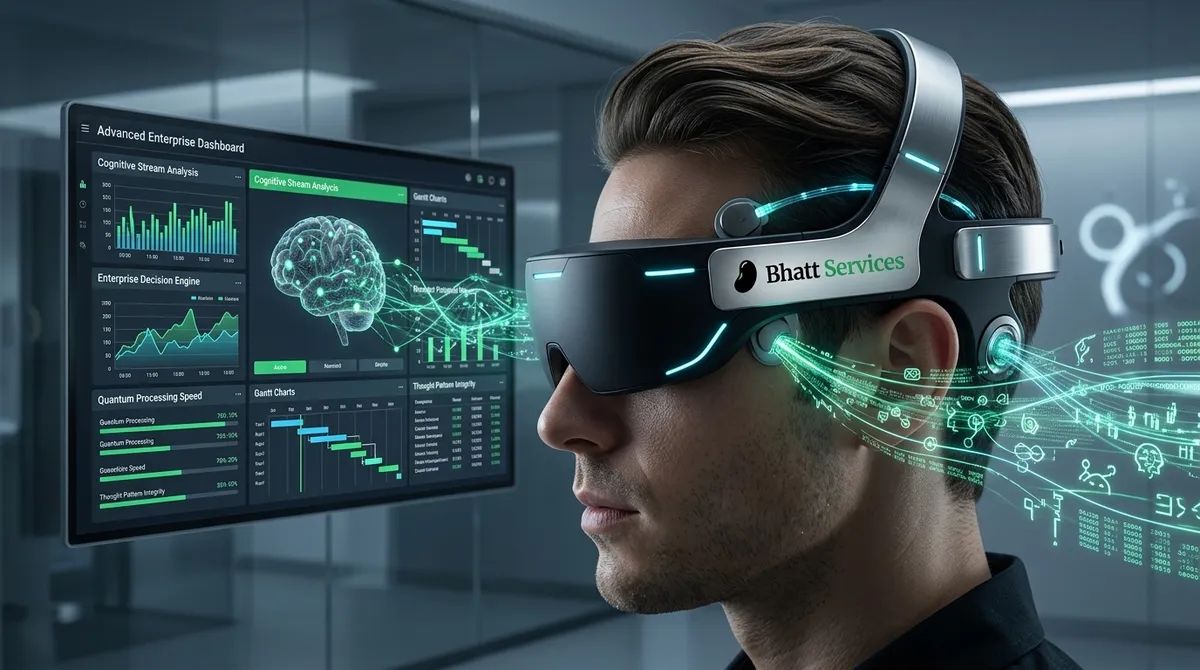
Brain-Computer Interfaces (BCI): Early Adopter Enterprise Use Cases
As we embark on a new decade of technological advancements, the realm of Brain-Computer Interfaces (BCI) is poised to revolutionize the way we interact with machines. At Bhatt Services, we're at the forefront of exploring the vast potential of BCI in enterprise settings. In this blog post, we'll delve into the early adopter use cases that are redefining the future of human-computer interaction.
Introduction to Brain-Computer Interfaces (BCI)
A Brain-Computer Interface (BCI) is a system that enables people to control devices or communicate with others using only their brain signals. This technology has been largely confined to the realm of research and academia, but recent breakthroughs have made it more accessible and viable for enterprise adoption. BCIs can be categorized into two primary types: invasive and non-invasive. Invasive BCIs involve implanting electrodes directly into the brain, while non-invasive BCIs use external sensors to detect brain activity.
Early Adopter Enterprise Use Cases for BCI
Several forward-thinking companies are already exploring the potential of BCI in various industries. One of the most promising use cases is in the field of accessibility. BCIs can enable people with disabilities to interact with devices and communicate with others in ways that were previously impossible. For instance, a person with paralysis can use a BCI to control a computer cursor or type messages using only their brain signals.
Another significant use case for BCI is in the realm of gaming and entertainment. Companies like Neurable and Interaxon are developing BCI-powered gaming platforms that allow players to control characters and interact with virtual environments using only their brain activity. This technology has the potential to revolutionize the gaming industry and create new forms of immersive entertainment.
BCI in Healthcare and Medicine
The healthcare industry is also poised to benefit significantly from the adoption of BCI technology. Researchers are exploring the use of BCIs to diagnose and treat neurological disorders such as epilepsy, Parkinson's disease, and depression. BCIs can also be used to develop personalized treatment plans and monitor patient progress in real-time.
Furthermore, BCIs can enable patients to control prosthetic limbs and exoskeletons using only their brain signals. This technology has the potential to significantly improve the quality of life for individuals with paralysis or limb loss. Companies like Kernel and Paradromics are already developing BCI-powered prosthetic limbs that can be controlled by the user's thoughts.
Challenges and Limitations of BCI Adoption
While the potential of BCI technology is vast, there are several challenges and limitations that must be addressed before widespread adoption can occur. One of the primary challenges is the development of more accurate and reliable brain-computer interfaces. Current BCIs often require extensive calibration and training, and can be prone to errors and interference.
Another significant challenge is the need for standardization and regulation in the BCI industry. As the technology continues to evolve, it's essential to establish clear guidelines and standards for the development and deployment of BCIs. This will help to ensure safety, security, and efficacy, and will facilitate the adoption of BCI technology across various industries.
Conclusion and Future Outlook
In conclusion, Brain-Computer Interfaces (BCI) are poised to revolutionize the way we interact with machines and each other. As the technology continues to evolve, we can expect to see widespread adoption across various industries, from healthcare and gaming to education and entertainment. At Bhatt Services, we're committed to exploring the vast potential of BCI and helping our clients to harness its power to drive innovation and growth.
As we look to the future, it's clear that BCI technology will play an increasingly important role in shaping the world of tomorrow. With its potential to enable new forms of human-computer interaction, improve accessibility, and drive innovation, BCI is an exciting and rapidly evolving field that holds tremendous promise for the future.