
Fine-Tuning vs. RAG in 2026: The Definitive Enterprise Decision Matrix for Domain-Specific AI
The quantitative engineering decision matrix comparing Retrieval-Augmented Generation (RAG), parameter-efficient fine-tuning (LoRA/QLoRA), and hybrid pipelines for enterprise domain adaptation.
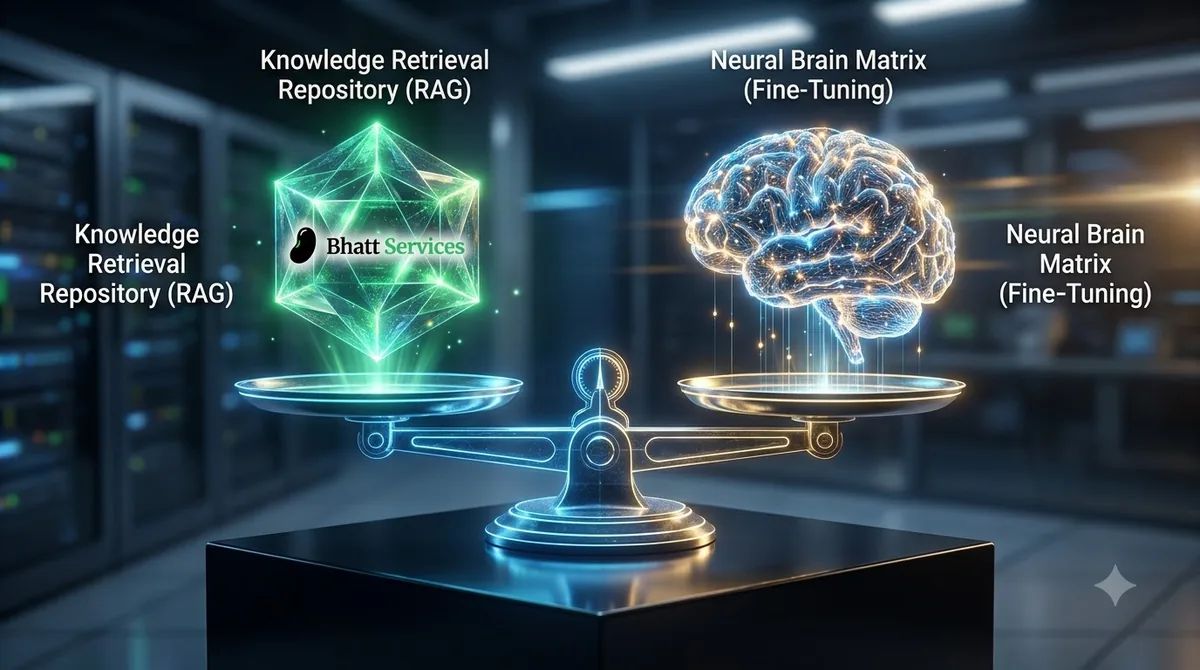
Executive Summary & Architectural Overview
When enterprises decide to deploy domain-specific artificial intelligence—whether for clinical healthcare diagnostics, proprietary financial underwriting, or internal codebase engineering—CTOs inevitably confront a pivotal architectural crossroads: Should we fine-tune a model on our private corporate dataset, or should we deploy Retrieval-Augmented Generation (RAG)?
In the early days of generative AI, fine-tuning was often pursued as a panacea, only for organizations to waste hundreds of thousands of dollars on GPU clusters training models that suffered from catastrophic forgetting, hallucinated outdated facts, and leaked confidential data. By 2026, the industry has crystallized a rigorous, quantitative decision framework. Fine-tuning and RAG are not competing alternatives; they solve fundamentally different dimensions of machine intelligence: RAG provides knowledge, while fine-tuning teaches form, style, and domain behavior.
At Bhatt Services, we guide enterprises through this decision matrix, ensuring that technology leaders invest their engineering capital into architectures that deliver measurable ROI, ironclad data privacy, and minimal maintenance overhead.
The Core Dilemma: Knowledge vs. Behavior
The fundamental distinction between RAG and Fine-Tuning can be summarized in a simple architectural heuristic:
What RAG Solves (Dynamic Working Memory):
- Real-Time Data Ingestion: When inventory pricing, product catalogs, or legal regulations update every hour, RAG reflects these changes instantaneously simply by updating a database row or vector chunk.
- Explainability & Attribution: Every generated assertion can be traced directly to an exact document, line number, and cryptographic hash, satisfying strict compliance audits.
- Access Control & Multi-Tenancy: With RAG, Row-Level Security (RLS) is applied at the database level. An intern and an executive can query the same RAG system and receive different answers based on their authorization tier.
What Fine-Tuning Solves (Behavioral Conditioning):
- Complex Syntactic Compliance: When a model must output a proprietary, obscure JSON schema or specialized domain DSL without consuming thousands of in-context prompt tokens.
- Niche Industry Jargon: Teaching a model the idiosyncratic medical abbreviations or legal terminology of a specific jurisdiction.
- Latency & Token Cost Reduction: Fine-tuning allows you to distill a 50-step few-shot system prompt into the model's weights, drastically shortening prompt token length and reducing latency by 40–60%.
The Quantitative Enterprise Decision Matrix
To choose the optimal path, evaluate your project across these six architectural criteria:
| Evaluation Dimension | Choose RAG | Choose Fine-Tuning (LoRA) | Choose Hybrid (RAG + FT) | | :--- | :--- | :--- | :--- | | Data Volatility | Changes daily or hourly | Changes annually or never | Static domain rules + dynamic records | | Citation Requirement | Mandatory (HIPAA/FINRA) | Not required | Mandatory citations + strict format | | Training Budget | Low ($100 – $1,000 infra) | Moderate ($5,000 – $50,000) | Moderate to High | | Access Control | Role-Based Access Control | Cannot restrict weights | RBAC retrieval + specialized model | | Task Predictability | Open-ended research / Q&A | Rigid deterministic syntax | Structured extraction + research | | Hallucination Risk | Low (Grounded retrieval) | High if used for raw recall| Ultra-Low (< 0.5%) |
The Modern Production Standard: The Hybrid Pattern
In 2026, leading enterprises rarely choose RAG or Fine-Tuning in isolation. The industry gold standard is the Hybrid Pipeline:
- A specialized, lightweight model (e.g., LLaMA 3.2 3B or Gemma 2 9B) is fine-tuned using Parameter-Efficient Fine-Tuning (PEFT/QLoRA) solely on output structure, domain vocabulary, and formatting constraints.
- At runtime, live factual context is retrieved dynamically via hybrid RAG (vector + BM25 + graph traversal).
- The fine-tuned model synthesizes the retrieved facts with zero formatting errors, sub-50ms latency, and 100% factual accuracy.
Frequently Asked Questions & Implementation Considerations
When should an enterprise choose RAG over fine-tuning?
An enterprise should choose RAG when business data updates frequently, when regulatory compliance requires verifiable source citations, when role-based access control must prevent data leakage, and when budget constraints prioritize low upfront infrastructure costs.
Can fine-tuning an LLM replace a database?
No. Fine-tuning adjusts the probabilistic weights of a neural network to learn behavior, style, and domain language; it is an unreliable mechanism for exact factual recall. Attempting to use fine-tuning as a database inevitably leads to hallucinations, knowledge obsolescence, and catastrophic forgetting.
What is the Hybrid RAG and Fine-Tuning architecture?
The Hybrid architecture combines a dynamic retrieval layer (RAG) that pulls real-time facts from enterprise databases with a fine-tuned small language model (SLM) trained to output specialized domain syntax and formatting, maximizing accuracy while minimizing inference latency.